A successful MVP launch is about more than releasing your product—it's about attracting the right early users, collecting actionable feedback, and iterating quickly. With the right pre-launch and post-launch strategies, you can validate your idea and build momentum for sustainable growth.
Launching a Minimum Viable Product (MVP) is an exciting milestone, but getting those first 50 users to try it can feel like a daunting task. This stage isn’t just about numbers—it’s about learning from real users, refining your product, and building momentum for growth.
This requires a thoughtful approach to connect with users, gather insights, and refine your product based on real-world feedback.
To make this process more manageable, we’ve broken down the [mvp](/blog/what-is-mvp-minimum-viable-product/) launch strategies into two key phases: pre-launch and post-launch. Pre-launch strategies are all about creating awareness, building anticipation, and attracting early users. Post-launch strategies, on the other hand, focus on engaging users, collecting feedback, and optimizing your product for success.
Understanding these two phases will help you approach your MVP validation systematically, ensuring you get the insights you need to grow. Let’s start by understanding the pre launch strategies to market your MVP.
## How to Promote Your MVP in 2026? \[MVP Launch Strategies\]
### Pre-Launch Stage: Building Anticipation
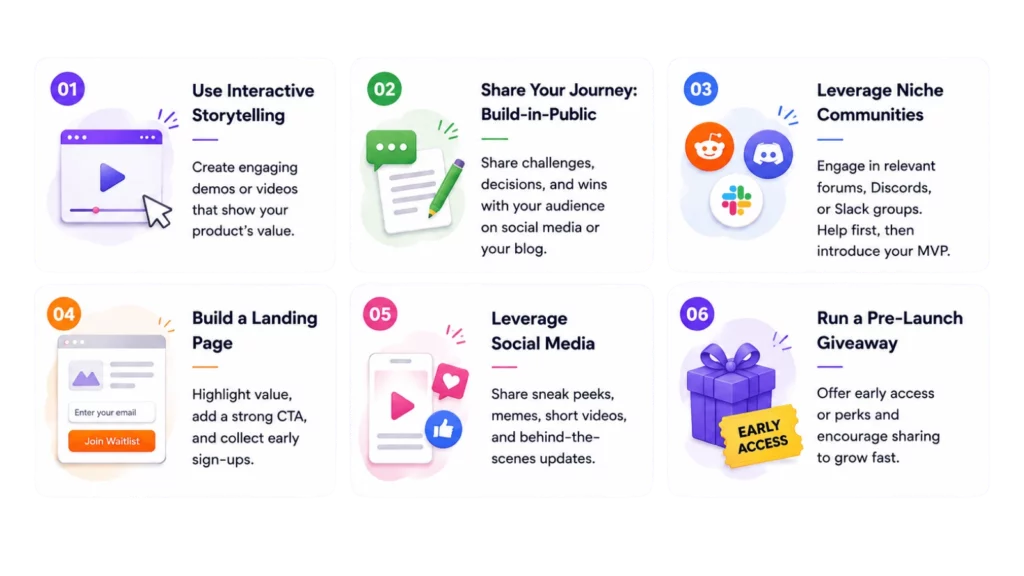
#### Use Interactive Storytelling
Before your MVP launch, create engaging and interactive experiences to build curiosity and explain your product's value proposition. For instance, [Dropbox](https://www.dropbox.com/) famously created a demo video that visually explained its concept to early users before development. This helped validate their idea and collect sign-ups.
Similarly, you could develop a small website showcasing a problem that your product solves interactively or create a relatable explainer video with tools like Canva or free interactive video makers.
#### Share Your Journey: Build-in-Public
Document the process of creating your MVP through social media updates, blog posts, or video snippets. This approach makes potential users feel invested in your journey and builds authenticity around your brand.
For example, startups like [Buffer](https://buffer.com/) and [Gumroad](https://gumroad.com/) have successfully used platforms like Twitter to share challenges, decisions, and milestones, turning their followers into early adopters. Highlight personal struggles and successes to connect emotionally with your audience.
#### Leverage Niche Forums and Communities
Instead of targeting crowded platforms, focus on engaging with smaller, relevant communities where your target audience interacts. Reddit groups, Discord servers, or Slack channels are great places to start.
For example, if your product targets developers, join forums like Stack Overflow or GitHub discussions. Participate in conversations, offer genuine advice, and subtly introduce your MVP as a solution to specific challenges.
#### Build a Landing Page with an Early Signup Form
Your MVP launch strategy begins with a simple, visually appealing landing page that highlights your product’s value proposition. Include a clear call-to-action (CTA) encouraging users to sign up for updates or an exclusive early access list.
Tools like [Unbounce](https://unbounce.com/) or [Carrd](https://carrd.co/) can help create professional pages quickly. For example, [Robinhood](https://robinhood.com/us/en/) famously grew its early user base by creating a landing page that positioned the app as exclusive and desirable, with a waitlist feature.
#### Leverage Social Media
Leverage social media to generate buzz with sneak peeks, product features, and behind-the-scenes updates. Use creative formats like memes, short videos, or GIFs to humorously highlight the problem your MVP solves and position your product as the solution.
You can create a meme about common user frustrations, followed by a post showing how your product fixes it, can boost engagement and shares while subtly promoting your brand.
#### Run a Pre-Launch Giveaway or Contest
Organize a giveaway that offers free access or perks related to your product. Encourage participants to share your product with their network to enter. For example, Dropbox's early referral program helped grow its waiting list exponentially.
## Platforms to Launch Your MVP to Validate Your Idea in 2026
| **Platform /** **“Tool” name** | **Who should launch there** | **What kind of products work** **best** |
| --- | --- | --- |
| Product Hunt | Startup founders, product leaders, and indie hackers who want a big, time‑boxed launch spike and broad awareness from early adopters and tech enthusiasts worldwide. | Polished MVPs in SaaS, AI tools, mobile apps, and consumer or productivity products that are easy to understand at a glance and ready for public use. |
| BetaList | Pre‑launch or very early‑stage founders who want to collect their first users, validate demand, and grow an email waitlist before a full public launch. | Early SaaS, web apps, and mobile apps that can offer beta access, “coming soon” pages, or private invites to test core value without being fully finished. |
| Indie Hackers | Solo founders, small bootstrapped teams, and indie hackers building online businesses who care about long‑term, community‑driven feedback over a one‑day launch spike. | Micro‑SaaS, B2B tools, niche web apps, info products, and other small, revenue‑focused projects that can evolve publicly with continuous input from peers. |
| Hacker News (Show HN) | Technical founders and developers who want brutally honest feedback from a highly technical audience and can handle a short but intense surge of attention. | Developer tools, APIs, open‑source projects, infrastructure products, and technically interesting SaaS where the engineering story is as important as the UI. |
| Launching Next | Early‑stage startup teams who want directory‑style exposure, backlinks, and a steady trickle of visitors instead of a one‑day launch event. | Web‑based startups, SaaS tools, and side projects that are ready to be listed alongside other new products for ongoing discovery and credibility. |
| OpenHunts / Open Launch‑style platforms | Indie makers and small teams who might get buried on Product Hunt and prefer smaller, maker‑centric communities where their projects can stand out more easily. | Indie projects, side hustles, and early SaaS or AI tools that benefit from “Product Hunt–like” feeds but with less competition and more supportive audiences. |
| AI tool directories (e.g., Futurepedia) | AI founders and builders whose target users actively browse curated AI directories to discover new tools and are eager to experiment. | AI apps, copilots, chatbots, agents, AI plugins, and AI‑powered features across categories like productivity, marketing, coding, and design. |
### 1\. Product Hunt
The flagship launchpad for new tech products, attracting millions of founders, investors, journalists, and early adopters every month.
- Huge, tech-savvy audience that can generate signups fast
- Voting and comments provide clear social proof and qualitative feedback
- Strong SEO and backlink potential from blogs and newsletters that monitor launches
### 2\. BetaList
Focused on pre-launch and beta-stage startups, giving MVPs visibility in front of early adopters who expect rough edges and are willing to provide feedback.
- Perfect for collecting waitlist signups before a full public launch
- Audience is primed to test unfinished products and report bugs
- Curated listings drive quality traffic and SEO-friendly links
### 3\. Indie Hackers
A founder-centric community where makers share launches, revenue milestones, and build-in-public journeys — ideal for ongoing validation beyond a single launch day.
- Feedback comes from founders and SaaS builders who understand MVP constraints
- Long-lived posts and build-in-public threads maintain visibility over time
- Great for testing positioning, pricing, and messaging with a B2B-heavy audience
### 4\. Hacker News (Show HN)
A section of Hacker News where makers share new projects with a highly technical, developer-focused audience that delivers intense, brutally honest feedback.
- Ideal for dev tools, APIs, and technical products aimed at engineers
- Strong traffic and signup spike if you reach the front page
- Comments often include deep technical critiques and feature suggestions
### 5\. Launching Next
A startup directory where founders submit new projects to be showcased to early adopters, startup enthusiasts, and other makers.
- Simple submission process makes it easy to list early MVPs
- Ongoing directory presence sends small, steady traffic over time
- Good supplement to bigger launches to diversify traffic sources and backlinks
### 6\. OpenHunts / Open Launch-style Platforms
Open-source, community-driven alternatives to Product Hunt with better discoverability for indie projects than crowded mainstream sites.
- Less saturated, so small-team MVPs can stand out more easily
- Community emphasis on indie makers rather than only VC-backed startups
- Useful as a rehearsal before a big Product Hunt or Show HN launch
### 7\. AI Tool Directories _(for AI-based MVPs)_
Specialized directories like **Futurepedia** and **There's An AI For That** list new tools for early adopters actively looking to try AI solutions.
- Directory backlinks and newsletter inclusion support early SEO and credibility
- Highly targeted audience already interested in experimenting with AI tools
- Category pages and tags help validate positioning against similar products
### Post Launch Stage: Refining and Engaging
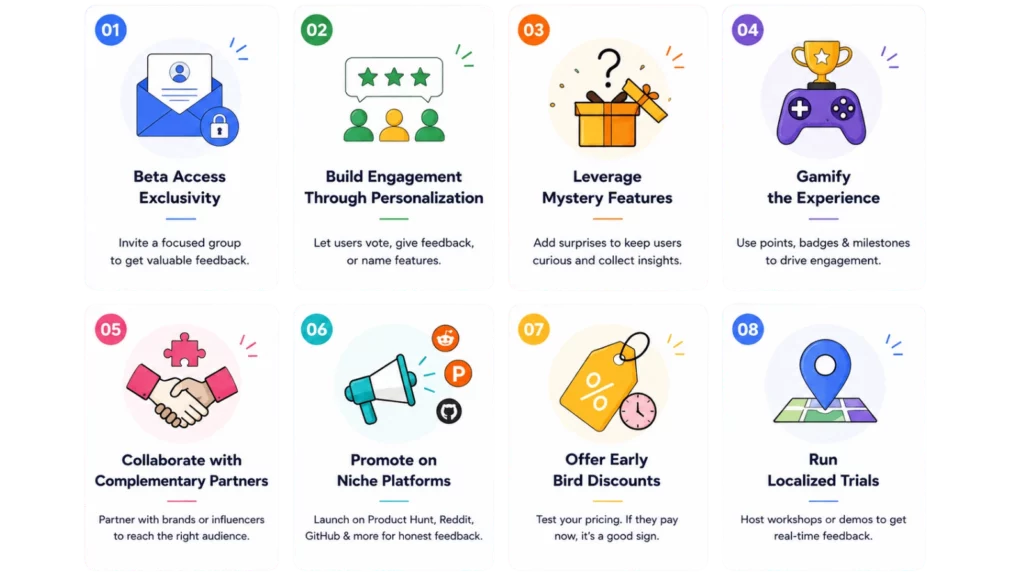
Once your MVP is live, the real work begins: validating whether it solves the problem you set out to address. This means connecting with users, gathering insights, and refining your product to ensure it truly resonates. Here’s how to get started:
#### Start with Beta Access Exclusivity
Think of your first users as your co-creators. By offering an invite-only beta program, you’re not just making them feel special—you’re creating a focused space to observe how they interact with your MVP.
Send out personalized invites to people who have shown genuine interest, like your early sign-ups or members of niche communities. Their feedback will help you identify what’s working and what needs tweaking. Plus, the exclusivity adds a bit of hype, making your product feel more desirable right from the start.
#### Build Engagement Through Personalization
People love to feel like they’re part of something, and your MVP can tap into that. Let your users contribute by voting on features, providing feedback, or even naming a tool or function.
This isn’t just about making them feel involved—it’s about understanding what really matters to your audience. Imagine saying, “Hey, you helped shape this product!” It builds loyalty and gives you valuable insights into their priorities, which helps you refine your MVP for the better.
#### Leverage Mystery Features
Everyone loves a little surprise! Adding hidden features or bonuses that users can unlock is a fun way to keep them curious and engaged. For example, you could add a reward for completing onboarding or achieving a specific milestone within your app.
This isn’t just about adding excitement—it’s a way to learn what delights your users and what feels unnecessary. The feedback you gather can guide your next steps in development.
#### Gamify the Experience
You know how satisfying it is to see a progress bar fill up or unlock a badge? You can use that same psychology to keep your users hooked. Add fun elements like points, milestones, or rewards for completing actions like setting up their profile or exploring key features.
It’s not just entertaining—it’s a way to validate what keeps your audience engaged. If users keep coming back for the game-like elements, it tells you what works and helps you build on those areas.
#### Collaborate with Complementary Partners
Sometimes, the best validation comes from stepping into new spaces. Think about brands or influencers who share your audience but aren’t direct competitors.
For example, if you’ve created a fitness tracker, partnering with a local gym or wellness influencer can introduce your product to the right people. Cross-promotions like this help you test your MVP’s appeal in different contexts and can generate fresh, valuable feedback.
#### Promote on Niche Platforms
Instead of trying to compete on crowded platforms, go where your potential users already are. Product Hunt, Reddit, GitHub—these are goldmines for gathering honest feedback.
These communities love discovering and testing new tools, and they won’t sugarcoat their opinions. Launching your MVP here helps you validate its unique value while collecting actionable insights to improve it.
#### Offer Early Bird Discounts
Your pricing model is just as important to validate as your product itself. Offering early bird discounts is a great way to test if your users find your product valuable enough to pay for it.
If people are willing to pay even a discounted rate, it’s a good sign you’re on the right track. Plus, it creates urgency for users to jump in, which can drive momentum and help you gather more data quickly.
#### **Run Localized Trials**
Sometimes, the best way to understand how your product fits into people’s lives is to meet them where they are. Hosting workshops, events, or trials in specific locations can give you real-time feedback on how people interact with your MVP.
For example, if you’re launching a productivity app, setting up a demo station at a coworking space can help you observe user reactions firsthand. These interactions can reveal things you’d never learn from online feedback alone.