---
title: "MVP Cost Breakdown: From $5k Lean Builds to $100k Enterprise Launches"
entityName: "EnactOn Technologies Private Limited"
pageType: "Article"
url: "https://www.enacton.com/blog/cost-to-build-an-mvp/"
rawMdUrl: "https://www.enacton.com/blog/cost-to-build-an-mvp.md"
lastUpdated: "2025-10-21"
---

# MVP Cost Breakdown: From $5k Lean Builds to $100k Enterprise Launches

## Additional Documentation & Details

<style>
  
  .content-strip {
    
    margin: 28px 0 !important;
    padding: 22px 28px !important;
    background: #f8fafc !important;
    border: 1px solid #e2e8f0 !important;
    border-left: 5px solid #4f46e5 !important;
    border-radius: 12px !important;
    box-sizing: border-box !important;
  }
  /* Header flex container to space tag and author */
  .content-strip .content-header {
    display: flex !important;
    align-items: center !important;
    justify-content: space-between !important;
    gap: 12px !important;
    margin-bottom: 12px !important;
  }
  .content-strip .content-label {
    display: inline-flex !important;
    align-items: center !important;
    gap: 6px !important;
    font-size: 11px !important;
    font-weight: 700 !important;
    text-transform: uppercase !important;
    letter-spacing: 0.08em !important;
    color: #4f46e5 !important;
    margin: 0 !important;
  }
  .content-strip .content-dot {
    width: 6px !important;
    height: 6px !important;
    background-color: #10b981 !important;
    border-radius: 50% !important;
    display: inline-block !important;
  }
  .content-strip .content-author {
    font-size: 12.5px !important;
    font-weight: 500 !important;
    color: #94a3b8 !important;
    margin: 0 !important;
    white-space: nowrap !important;
  }
  .content-strip h3 {
    color: #0f172a !important;
    font-size: 18px !important;
    font-weight: 700 !important;
    line-height: 1.35 !important;
    margin: 0 0 10px 0 !important;
    letter-spacing: -0.01em !important;
  }
  .content-strip p.content-body {
    color: #475569 !important;
    font-size: 14.5px !important;
    font-weight: 500 !important;
    line-height: 1.6 !important;
    margin: 0 0 12px 0 !important;
  }
  .content-strip p.content-body:last-child {
    margin-bottom: 0 !important;
  }
  /* Inline Links */
  .content-strip a.content-link {
    color: #4f46e5 !important;
    font-weight: 600 !important;
    text-decoration: underline !important;
    text-underline-offset: 2px !important;
    transition: color 0.15s ease !important;
  }
  .content-strip a.content-link:hover {
    color: #3730a3 !important;
  }
  @media (max-width: 640px) {
    .content-strip { padding: 18px 20px !important; }
    .content-strip .content-header {
      flex-wrap: wrap !important;
      gap: 4px !important;
    }
  }
</style>
<div class="content-strip">
  <div class="content-header">
    <div class="content-label">
      <span class="content-dot"></span>THE SHORT ANSWER
    </div>
  </div>
  <p class="content-body">
    MVP development costs in 2026 typically range from $5K for lean, focused builds to $100K+ for enterprise-grade products. The final cost depends on your product's complexity, features, integrations, and development approach, but smart scoping can dramatically reduce both budget and risk.
  </p>
</div>

The cost to build an MVP in 2026 runs from about **$5,000 for a lean, well-scoped build to $100,000+ for complex enterprise products**, and where you land depends on five things: feature count, platforms, integrations, AI/real-time needs, and who builds it. Here's the honest breakdown most agencies won't give you: **the majority of founders need $5,000–$10,000**, not $100,000, because a properly scoped first version cuts non-essential features from the initial whitelist before a line of code is written. This guide gives you real per-tier and per-feature numbers so you can budget before you ever talk to a vendor.

At EnactOn, we have seen MVPs become the launchpad for global companies. Founders want the same thing: proof that their idea works, without draining budgets. MVPs are popular because they provide clarity. Instead of building everything at once, you invest just enough to learn. The question then becomes: _What should I budget, and where will the money go?_

MVPs remain attractive because they also create alignment. Founders, developers, and investors work around a shared minimum scope, reducing miscommunication. In 2026, when SaaS ideas face global competition, the [AI-first dilemma](/blog/ai-first-business/) and shorter attention spans, the speed of validation matters as much as funding. That is why the minimum viable product cost deserves close analysis.

## **What Is an MVP?**

**A** [**Minimum Viable Product**](/blog/what-is-mvp-minimum-viable-product/) **(MVP) is the earliest working version of a product designed to solve one problem and deliver usable feedback from real users.**

Prototypes and wireframes are helpful for internal validation, while an MVP goes a step further. It is released into the market, used by real customers, and produces measurable data on adoption, engagement, and willingness to pay.

For founders, the cost to build an MVP comes down to building a version that balances speed and clarity. The goal is to focus on a single core feature, gather responses, and understand what users value most. This makes minimum viable product cost a question of efficiency: how fast you can learn while keeping development lean.

In 2026, MVPs remain central to SaaS and product strategy. Investors want traction before funding, and customers prefer tools that provide immediate value. A lean, focused MVP creates both early confidence for backers and clear insights for teams who want to scale.

## **Why Build an MVP? (Purpose & Benefits)**

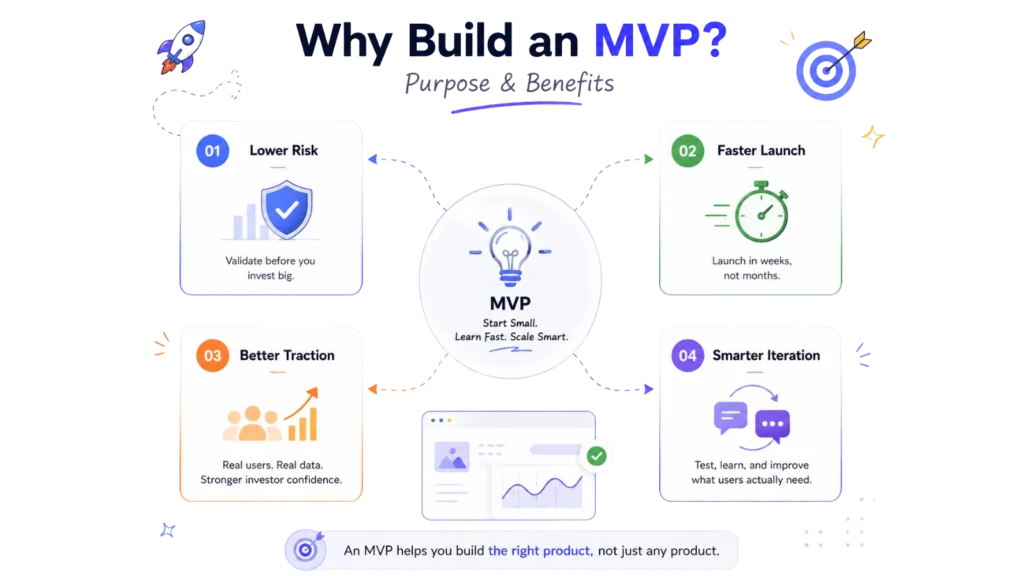
**An MVP reduces financial risk, accelerates timelines, and improves investor confidence.**
![Why Build an MVP? ](/images/Blog-Images-13-1024x576.webp)

**1\. De-risking investment  
**CB Insights reports that [**42% of startups fail**](https://www.cbinsights.com/research/report/startup-failure-reasons-top/) because there is no market need. An MVP avoids this mistake by validating the need before scaling. Teams that validate cut post-launch rework significantly, saving budget and resources.  
**2\. Faster time-to-market  
**A SaaS MVP can launch in 8–12 weeks, while full products often take 6–12 months. In 2026, where competition is global and investor patience is shorter, speed matters as much as funding.  
**3\. Investor traction  
**Seed funds increasingly look for user data. Founders with even modest traction from an MVP raise money [**30% faster**](https://www.hubspot.com/startups/fundraising/preseed-vs-seed-funding#:~:text=However%2C%20for%20seed%20funding%2C%20startups,additional%20funding%20into%20business%20development.) and at better terms than teams with only pitch decks.  
4\. **User-driven iteration  
**An MVP creates feedback loops. Instead of assuming what users want, you test, measure, and adjust. This keeps MVP development cost tied to outcomes rather than assumptions.

Beyond these direct benefits, MVPs also improve internal decision-making. Teams avoid endless debates about features and instead focus on measurable outcomes. This shift in mindset allows startups to grow sustainably while controlling their minimum viable product cost.

## **Key Factors Influencing MVP Cost**

The cost to build an MVP is shaped by complexity, features, design depth, technology choices, and the team. At Enacton, we have structured our [MVP development services](/mvp-development-services-for-startups/) to take into account the following:

#### **1\. App Complexity**

- **Basic MVPs:** login, one core workflow, essential backend: from **$5K ($5K–$10K)**

- **Standard MVPs:** multi-role logic, admin dashboard, third-party integrations: from **$10K ($10K–$20K)**

- **Advanced MVPs:** AI modules, real-time sync, scale-ready architecture: from **$20K ($20K–$35K)**

- **Enterprise MVPs:** compliance-heavy, complex AI, or high-scale builds: from **$35K ($35K–$100K+)**

Each layer of complexity adds weeks of coding and QA and hence adds to the minimum viable product cost. For example, real-time messaging can add **$10k–$15k** alone. Startups should carefully balance ambition with the minimum scope needed to validate demand.

#### **2\. Features & Functionalities**

Features account for the largest swings in MVP development cost.

- Authentication and login: **$1k–$3k**

- Payment systems: **$3k–$7k**

- Chat/messaging: **$5k–$10k**

- Analytics dashboards: **$10k–$15k**

- AI features: **$20k+**

It is crucial to align features with the core user journey. Adding extras early often delays launch and reduces focus.

#### **3\. Platforms (iOS, Android, Web)**

Building for Web alone reduces MVP app cost by [up to **45%**](https://www.armia.com/blog/web-and-mobile-app-development-key-differences-you-need-to-know/). Adding iOS and Android means separate codebases or frameworks and triple the testing. Multi-platform launches make sense for products like fintech or healthcare apps where mobile adoption is non-negotiable.

A smart strategy is to test traction on Web, then expand once clear demand is visible. This approach keeps costs lean and ensures resources are invested wisely.

#### **4\. Design Requirements**

- Basic template UI is cheapest.

- Custom branded UI with accessibility compliance can add **$5k–$20k**.

- Micro-animations and advanced UX for SaaS dashboards raise budgets further.

Well-designed interfaces also lower churn. Research shows that **88% of users do not return to apps with poor usability**, which makes design a cost worth planning for.

#### **5\. Tech Stack**

- Common stacks like React, Node.js, and Flutter are affordable and talent-rich.

- AI, blockchain, or AR stacks increase MVP development cost by 15–25%.

- Using modern frameworks also reduces maintenance cost over time.

Selecting a stack should align with the long-term roadmap, not just MVP launch. Choosing an obscure technology may save in the short run but increase costs later due to limited talent.

#### **6\. Location & Hourly Rates of Developers**

- US/Western Europe: **$80–$120/hour**

- Eastern Europe: **$40–$70/hour**

- India: **$25–$50/hour**

The same MVP may cost $25,000 offshore but $75,000 in Silicon Valley. Many startups now adopt hybrid models: architect in the US, development pod in India. This balance keeps MVP app cost competitive while maintaining quality.

#### **7\. Development Team Composition**

A team may include:

- Product Manager

- 1–3 Developers

- Designer

- QA Tester

- DevOps Engineer

Each role adds about **$5k/month** at blended rates. Larger teams shorten timelines but raise MVP app cost. Founders should decide whether speed or budget is the bigger priority.

<style>
  
  /* Main CTA container */
  div.enacton-process-cta {
    width: 100% !important;
    max-width: 100% !important;
    margin: 36px 0 !important;
    padding: 22px 28px !important;
    box-sizing: border-box !important;
    display: flex !important;
    align-items: center !important;
    justify-content: space-between !important;
    gap: 24px !important;
    position: relative !important;
    overflow: hidden !important;
    background: #ffffff !important;
    border: 1px solid #e2e8f0 !important;
    border-left: 5px solid #4f46e5 !important;
    border-radius: 12px !important;
    box-shadow: 0 4px 20px -4px rgba(15, 23, 42, 0.08) !important;
    
  }
  /* Left content */
  div.enacton-process-cta .enacton-process-cta-content {
    display: flex !important;
    flex: 1 1 auto !important;
    flex-direction: column !important;
    align-items: flex-start !important;
    gap: 7px !important;
    min-width: 0 !important;
    margin: 0 !important;
    padding: 0 !important;
  }
  /* Small tag */
  div.enacton-process-cta .enacton-process-cta-tag {
    display: inline-flex !important;
    align-items: center !important;
    gap: 7px !important;
    margin: 0 !important;
    padding: 0 !important;
    color: #4f46e5 !important;
    
    font-size: 11px !important;
    font-weight: 700 !important;
    line-height: 1.2 !important;
    letter-spacing: 0.06em !important;
    text-transform: uppercase !important;
  }
  div.enacton-process-cta .enacton-process-cta-tag span {
    margin: 0 !important;
    padding: 0 !important;
    color: #4f46e5 !important;
    font-size: 11px !important;
    font-weight: 700 !important;
    line-height: 1.2 !important;
  }
  /* Green dot */
  div.enacton-process-cta .enacton-process-cta-dot {
    display: inline-block !important;
    flex: 0 0 6px !important;
    width: 6px !important;
    min-width: 6px !important;
    max-width: 6px !important;
    height: 6px !important;
    min-height: 6px !important;
    max-height: 6px !important;
    margin: 0 !important;
    padding: 0 !important;
    background-color: #10b981 !important;
    border: 0 !important;
    border-radius: 50% !important;
  }
  /* Main CTA text */
  div.enacton-process-cta p.enacton-process-cta-text {
    display: block !important;
    margin: 0 !important;
    padding: 0 !important;
    color: #0f172a !important;
    
    font-size: 15px !important;
    font-weight: 600 !important;
    line-height: 1.45 !important;
    letter-spacing: -0.01em !important;
  }
  /* CTA button */
  div.enacton-process-cta a.enacton-process-cta-button {
    display: inline-flex !important;
    flex: 0 0 auto !important;
    align-items: center !important;
    justify-content: center !important;
    gap: 8px !important;
    width: auto !important;
    min-width: auto !important;
    height: auto !important;
    margin: 0 !important;
    padding: 12px 22px !important;
    box-sizing: border-box !important;
    background-color: #0f172a !important;
    border: 0 !important;
    border-radius: 8px !important;
    color: #ffffff !important;
    
    font-size: 13.5px !important;
    font-weight: 600 !important;
    line-height: 1.2 !important;
    letter-spacing: -0.01em !important;
    text-decoration: none !important;
    text-transform: none !important;
    white-space: nowrap !important;
    cursor: pointer !important;
    transition:
      background-color 0.2s ease,
      transform 0.2s ease,
      box-shadow 0.2s ease !important;
  }
  div.enacton-process-cta a.enacton-process-cta-button span {
    display: inline !important;
    margin: 0 !important;
    padding: 0 !important;
    color: #ffffff !important;
    
    font-size: 13.5px !important;
    font-weight: 600 !important;
    line-height: 1.2 !important;
  }
  div.enacton-process-cta a.enacton-process-cta-button:hover,
  div.enacton-process-cta a.enacton-process-cta-button:focus {
    background-color: #4f46e5 !important;
    color: #ffffff !important;
    text-decoration: none !important;
    transform: translateY(-1px) !important;
    box-shadow: 0 4px 14px rgba(79, 70, 229, 0.3) !important;
  }
  /* Arrow icon */
  div.enacton-process-cta a.enacton-process-cta-button svg {
    display: block !important;
    flex: 0 0 14px !important;
    width: 14px !important;
    min-width: 14px !important;
    max-width: 14px !important;
    height: 14px !important;
    min-height: 14px !important;
    max-height: 14px !important;
    margin: 0 !important;
    padding: 0 !important;
    overflow: visible !important;
    fill: none !important;
    stroke: #ffffff !important;
    stroke-width: 2.2 !important;
    stroke-linecap: round !important;
    stroke-linejoin: round !important;
    transition: transform 0.2s ease !important;
  }
  div.enacton-process-cta a.enacton-process-cta-button svg path {
    fill: none !important;
    stroke: #ffffff !important;
    stroke-width: 2.2 !important;
    stroke-linecap: round !important;
    stroke-linejoin: round !important;
  }
  div.enacton-process-cta a.enacton-process-cta-button:hover svg {
    transform: translateX(3px) !important;
  }
  /* Mobile layout */
  @media screen and (max-width: 640px) {
    div.enacton-process-cta {
      flex-direction: column !important;
      align-items: flex-start !important;
      gap: 18px !important;
      margin: 28px 0 !important;
      padding: 20px !important;
    }
    div.enacton-process-cta a.enacton-process-cta-button {
      width: 100% !important;
      justify-content: center !important;
      white-space: normal !important;
      text-align: center !important;
    }
  }
</style>
<div class="enacton-process-cta" role="complementary" aria-label="MVP development process guide" >
  <div class="enacton-process-cta-content">
    <div class="enacton-process-cta-tag">
      <span class="enacton-process-cta-dot" aria-hidden="true" ></span>
      <span>MVP Cost by Phase</span>
    </div>
    <p class="enacton-process-cta-text">
      MVP costs vary by phase, from discovery and design to development, QA,
      and launch.
    </p>
  </div>
  <a href="/blog/mvp-development-process/" class="enacton-process-cta-button" aria-label="View EnactOn's MVP development process guide" >
    <span>View the Process Guide</span>
    <svg width="14" height="14" viewBox="0 0 24 24" xmlns="http://www.w3.org/2000/svg" aria-hidden="true" focusable="false" >
      <path d="M5 12H19M12 5L19 12L12 19"></path>
    </svg>
  </a>
</div>

## **MVP Development Cost Breakdown: What Each Budget Actually Buys**

**How much does it cost to build an MVP in the AI era?** Realistically, **$5,000** for a focused, single-workflow validation build, up to **$100,000** for an AI-powered, enterprise-ready platform. These numbers reflect AI-accelerated development. Our team uses the same class of tools you'd use solo, but with senior engineering review, security hardening, and architecture decisions layered on top, which is why the cost stays close to what a bootstrapped or pre-seed founder can actually justify.

| Tier | Budget | Timeline | What you get |
| --- | --- | --- | --- |
| **Basic MVP** ⭐ | $5K–$10K | 8–12 weeks | Discovery + ruthless scoping, UI/UX for core flows, one production-grade platform (web or mobile), auth + user roles, the core workflow end-to-end, one key integration (e.g., payments), basic admin + analytics, QA, launch, post-launch support window |
| **Standard MVP** | $10K–$20K | 10–15 weeks | Everything in Basic + multiple user roles, full admin dashboard, several integrations, richer analytics/reporting, secondary features |
| **Advanced MVP** | $20K–$35K | 15–20 weeks | Everything in Standard + AI/ML or real-time functionality, scale-ready architecture, security hardening |
| **Enterprise MVP** | $35K–$100K+ | 20–30+ weeks | Compliance-heavy, complex AI, or high-scale enterprise builds, big-firm scope without the big-firm invoice |

<style>
  
  .content-strip {
    
    margin: 28px 0 !important;
    padding: 20px 24px !important;
    background: #f8fafc !important;
    border: 1px solid #e2e8f0 !important;
    border-left: 4px solid #4f46e5 !important;
    border-radius: 12px !important;
    box-sizing: border-box !important;
  }
  .content-strip .content-label {
    display: flex !important;
    align-items: center !important;
    gap: 6px !important;
    font-size: 11px !important;
    font-weight: 700 !important;
    text-transform: uppercase !important;
    letter-spacing: 0.08em !important;
    color: #4f46e5 !important;
    margin-bottom: 6px !important;
  }
  .content-strip .content-dot {
    width: 6px !important;
    height: 6px !important;
    background-color: #10b981 !important;
    border-radius: 50% !important;
    display: inline-block !important;
  }
  .content-strip h3 {
    color: #0f172a !important;
    font-size: 18px !important;
    font-weight: 700 !important;
    line-height: 1.35 !important;
    margin: 0 0 8px 0 !important;
    letter-spacing: -0.01em !important;
  }
  .content-strip p.content-body {
    color: #475569 !important;
    font-size: 14.5px !important;
    font-weight: 500 !important;
    line-height: 1.6 !important;
    margin: 0 !important;
  }
  @media (max-width: 640px) {
    .content-strip { padding: 16px 18px !important; }
  }
</style>
<div class="content-strip">
  <h3>A Note on “Basic”</h3>
  <p class="content-body">
    At EnactOn, the Basic tier isn’t stripped-down; it deliberately over-delivers into what many agencies scope as a “Medium” build. What large firms quote $30,000+ for, we deliver from $5,000. Not by cutting corners, but by scoping like founders, because we are founders: we’ve built, launched, and monetized our own products, so we know exactly which 30–40% of a feature wishlist can wait until after launch. That’s also why most of our clients never need more than the Basic tier to reach real users and investors.
  </p>
</div>

**Basic MVP Cost: $5,000 – $10,000**

A Basic MVP is the fastest, lowest-risk way to test whether real users want your product before you commit serious budget. It's deliberately close to what a solo founder might spend stitching together no-code tools and a Lovable subscription, except it ships with proper authentication, real testing, and a codebase you actually own and can build on.

****What you get for** $5,000 – $10,000:**

- User authentication (email or social login via Google/Apple)

- One core feature or workflow built fully end-to-end, not mocked up

- A clean, functional UI focused on usability over visual polish

- Manual QA testing on the primary user flow — catching the failure modes vibe-coded apps typically ship with

- Live deployment to a cloud server with a codebase that's actually yours, no vendor lock-in

- Basic analytics so you can see whether anyone actually uses it

- 1–2 week post-launch bug-fix window

This tier runs 8–12 weeks with a lean 2–3 person team and is the right starting point if you can describe your product's job in a single sentence.

**Standard MVP Cost: $10,000 – $20,000**

Once a Basic MVP proves people want what you're building, a Standard MVP turns it into something that can actually run as a business — more features, a way to manage the product without touching a database directly, and the integrations users expect from a real tool. This is also roughly where DIY vibe-coding starts breaking down hardest: multiple features, real user roles, and payment handling are exactly the combination that produces the security gaps in the data above.

**What you get for $10,000–$20,000:**

- 3–5 core features prioritized by what early users actually requested

- Admin panel for managing users, content, and data without developer help

- Payment integration (Stripe or Razorpay) for subscriptions or one-time purchases, properly handling failed payments and edge cases

- Multi-role access control (e.g., admin vs. standard user permissions)

- 1–2 third-party integrations (CRM, calendar, email, or communication tools)

- Automated testing for core flows to prevent regressions

- Staging and production environments for safer deployments

- 2–4 week post-launch support sprint

This tier runs 10–15 weeks with a 4–5 person team and is the stage most early-stage startups launch at, since it's the first version capable of generating real, defensible revenue.

**Advanced MVP Cost: $20,000 – $35,000**

An Advanced MVP is for founders who have outgrown a simple tool and need AI or real-time capability to compete for bigger customers. This is the tier where the product starts doing genuine work for the user, not just storing and displaying their data.

**What you get for $20,000–$35,000:**

- AI/ML feature integration (recommendation engines, chat assistants, predictive scoring, or automation), built and reviewed, not just prompted into existence

- Multi-tenant SaaS architecture with isolated data per customer organization

- Advanced role-based access control (RBAC) with custom permission sets

- Auto-scaling cloud infrastructure built to handle real production traffic

- Native mobile app (iOS/Android) where the use case requires it

- Automated testing across core and edge-case flows

- 3–4 week post-launch optimization sprint

This tier runs 15–20 weeks with a focused team including a senior engineer and dedicated QA, and is the right investment once your product needs to compete on capability, not just cost.

**Enterprise MVP Cost: $35,000 – $100,000+**

An Enterprise MVP exists for one reason: closing deals with customers whose procurement and IT teams will not sign off without proof. AI features and a polished UI are not enough at this tier, what closes the deal is the compliance, security, and audit trail behind it.

**What you get for $35,000–$100,000+:**

- SOC-2 readiness, audit logging, access controls, and documented security processes

- Single Sign-On (SSO) support for Okta, Azure AD, or Google Workspace

- Dedicated compliance and security review alongside standard QA

- Custom integrations with the enterprise systems your customer already runs on

- High-availability architecture built for uptime guarantees and SLAs

- 4–6-week post-launch optimization sprint

This tier runs 20–30+ weeks with a senior architect, dedicated security review, and a team sized to the actual scope, since cost and timeline here depend entirely on which compliance frameworks and integrations your enterprise customer requires. It's the right investment once an actual enterprise prospect, not a hypothetical one, is asking for these capabilities.

## **MVP Cost by Product Type**

Tier explains _how much_; product type explains _why_. Typical all-in ranges when built by an efficient offshore-senior team like ours:

| Product type | Typical range | What drives the cost | Typical tier |
| --- | --- | --- | --- |
| SaaS web app | $5K–$20K | Auth, billing, dashboard, one core workflow | Basic–Standard |
| Mobile app (iOS/Android) | $8K–$25K | Cross-platform framework, push, app-store release | Basic–Standard |
| Marketplace (two-sided) | $12K–$35K | Two user types, search, payments/escrow, liquidity tooling | Standard–Advanced |
| AI-powered product | $15K–$35K | Model integration, data pipeline, review/evaluation loop | Advanced |
| Healthtech / regulated | $20K–$100K+ | Compliance (e.g., HIPAA), audit trails, security review | Advanced–Enterprise |
| Fintech / payments | $20K–$100K+ | Transaction integrity, fraud controls, compliance | Advanced–Enterprise |

<style>
  
  /* Main CTA container */
  div.enacton-mvp-cta {
    width: 100% !important;
    max-width: 100% !important;
    margin: 36px 0 !important;
    padding: 22px 28px !important;
    box-sizing: border-box !important;
    display: flex !important;
    align-items: center !important;
    justify-content: space-between !important;
    gap: 24px !important;
    position: relative !important;
    overflow: hidden !important;
    background: #ffffff !important;
    border: 1px solid #e2e8f0 !important;
    border-left: 5px solid #4f46e5 !important;
    border-radius: 12px !important;
    box-shadow: 0 4px 20px -4px rgba(15, 23, 42, 0.08) !important;
    
  }
  /* Left-side content */
  div.enacton-mvp-cta .enacton-mvp-cta-content {
    display: flex !important;
    flex: 1 1 auto !important;
    flex-direction: column !important;
    align-items: flex-start !important;
    gap: 7px !important;
    min-width: 0 !important;
    margin: 0 !important;
    padding: 0 !important;
  }
  /* Small heading/tag */
  div.enacton-mvp-cta .enacton-mvp-cta-tag {
    display: inline-flex !important;
    align-items: center !important;
    gap: 7px !important;
    margin: 0 !important;
    padding: 0 !important;
    color: #4f46e5 !important;
    
    font-size: 11px !important;
    font-weight: 700 !important;
    line-height: 1.2 !important;
    letter-spacing: 0.06em !important;
    text-transform: uppercase !important;
  }
  div.enacton-mvp-cta .enacton-mvp-cta-tag span {
    margin: 0 !important;
    padding: 0 !important;
    color: #4f46e5 !important;
    font-size: 11px !important;
    font-weight: 700 !important;
    line-height: 1.2 !important;
  }
  /* Green dot */
  div.enacton-mvp-cta .enacton-mvp-cta-dot {
    display: inline-block !important;
    flex: 0 0 6px !important;
    width: 6px !important;
    min-width: 6px !important;
    max-width: 6px !important;
    height: 6px !important;
    min-height: 6px !important;
    max-height: 6px !important;
    margin: 0 !important;
    padding: 0 !important;
    background-color: #10b981 !important;
    border: 0 !important;
    border-radius: 50% !important;
  }
  /* Main CTA sentence */
  div.enacton-mvp-cta p.enacton-mvp-cta-text {
    display: block !important;
    margin: 0 !important;
    padding: 0 !important;
    color: #0f172a !important;
    
    font-size: 15px !important;
    font-weight: 600 !important;
    line-height: 1.45 !important;
    letter-spacing: -0.01em !important;
  }
  /* CTA button */
  div.enacton-mvp-cta a.enacton-mvp-cta-button {
    display: inline-flex !important;
    flex: 0 0 auto !important;
    align-items: center !important;
    justify-content: center !important;
    gap: 8px !important;
    width: auto !important;
    min-width: auto !important;
    height: auto !important;
    margin: 0 !important;
    padding: 12px 22px !important;
    box-sizing: border-box !important;
    background-color: #0f172a !important;
    border: 0 !important;
    border-radius: 8px !important;
    color: #ffffff !important;
    
    font-size: 13.5px !important;
    font-weight: 600 !important;
    line-height: 1.2 !important;
    letter-spacing: -0.01em !important;
    text-decoration: none !important;
    text-transform: none !important;
    white-space: nowrap !important;
    cursor: pointer !important;
    transition:
      background-color 0.2s ease,
      transform 0.2s ease,
      box-shadow 0.2s ease !important;
  }
  div.enacton-mvp-cta a.enacton-mvp-cta-button span {
    display: inline !important;
    margin: 0 !important;
    padding: 0 !important;
    color: #ffffff !important;
    
    font-size: 13.5px !important;
    font-weight: 600 !important;
    line-height: 1.2 !important;
    text-decoration: none !important;
  }
  div.enacton-mvp-cta a.enacton-mvp-cta-button:hover,
  div.enacton-mvp-cta a.enacton-mvp-cta-button:focus {
    background-color: #4f46e5 !important;
    color: #ffffff !important;
    text-decoration: none !important;
    transform: translateY(-1px) !important;
    box-shadow: 0 4px 14px rgba(79, 70, 229, 0.3) !important;
  }
  /* Arrow icon */
  div.enacton-mvp-cta a.enacton-mvp-cta-button svg {
    display: block !important;
    flex: 0 0 14px !important;
    width: 14px !important;
    min-width: 14px !important;
    max-width: 14px !important;
    height: 14px !important;
    min-height: 14px !important;
    max-height: 14px !important;
    margin: 0 !important;
    padding: 0 !important;
    overflow: visible !important;
    fill: none !important;
    stroke: #ffffff !important;
    stroke-width: 2.2 !important;
    stroke-linecap: round !important;
    stroke-linejoin: round !important;
    transition: transform 0.2s ease !important;
  }
  div.enacton-mvp-cta a.enacton-mvp-cta-button svg path {
    fill: none !important;
    stroke: #ffffff !important;
    stroke-width: 2.2 !important;
    stroke-linecap: round !important;
    stroke-linejoin: round !important;
  }
  div.enacton-mvp-cta a.enacton-mvp-cta-button:hover svg {
    transform: translateX(3px) !important;
  }
  /* Mobile layout */
  @media screen and (max-width: 640px) {
    div.enacton-mvp-cta {
      flex-direction: column !important;
      align-items: flex-start !important;
      gap: 18px !important;
      margin: 28px 0 !important;
      padding: 20px !important;
    }
    div.enacton-mvp-cta a.enacton-mvp-cta-button {
      width: 100% !important;
      justify-content: center !important;
      white-space: normal !important;
      text-align: center !important;
    }
  }
</style>
<div class="enacton-mvp-cta" role="complementary" aria-label="BondMeds Telehealth Case Study" >
  <div class="enacton-mvp-cta-content">
    <div class="enacton-mvp-cta-tag">
      <span class="enacton-mvp-cta-dot" aria-hidden="true"></span>
      <span>CASE STUDY: BONDMEDS</span>
    </div>
    <p class="enacton-mvp-cta-text">
      Our BondMeds telehealth build shipped as an MVP in 12 weeks with 1,200+ subscribers in 3 months.
    </p>
  </div>
  <a href="/portfolio/bondmeds/" class="enacton-mvp-cta-button" aria-label="View BondMeds Case Study" >
    <span>View BondMeds Case Study</span>
    <svg width="14" height="14" viewBox="0 0 24 24" xmlns="http://www.w3.org/2000/svg" aria-hidden="true" focusable="false" >
      <path d="M5 12H19M12 5L19 12L12 19"></path>
    </svg>
  </a>
</div>

## **Hidden or Additional Costs of MVP Development**

What founders often forget is that MVP budgets don’t end when coding stops. Hosting, monitoring, and security are ongoing. A payment processing SaaS we built faced recurring SDK charges of nearly **$400 a month** for fraud detection tools. Those charges were small compared to development, but unavoidable.

Compliance costs also creep in. A health-tech startup we partnered with had to spend an additional **$7,500** for HIPAA audits before onboarding its first users. None of this showed up in their initial spreadsheet.

Post-launch support is another layer. Even a lean SaaS MVP will need bug fixes and UI polish after early users start giving feedback. On average, teams should expect around **20% of the original build cost** to go back into the product within the first year.

## **Cost-Saving Strategies for MVP Development**

Founders can reduce MVP development cost by planning smartly and leveraging proven tools.

● Start with one workflow that defines value.  
● Use open-source libraries and low-code solutions to save development hours.  
● Launch on Web before expanding to mobile.  
● Blend teams: senior architect locally, development offshore.

Every dollar saved in early builds is better used for marketing and growth. This mindset keeps MVP app cost manageable while maximizing learning.

**The biggest cost-saver: a fixed budget instead of an hourly meter.** Hourly billing puts all the risk on you; every revision, every meeting, every delay runs the meter. A fixed-scope, fixed-price engagement flips that: you know the full number before work starts, and the builder carries the efficiency risk. It's how EnactOn runs most engagements, and it's the single most reliable way to keep an MVP from quietly doubling in cost.

## **Examples of Successful MVPs**

SaaS history is filled with stories of lean builds that turned into category leaders.

● **Intercom** began with a small widget that allowed website owners to chat with users in real time. That narrow MVP became the foundation of a customer engagement company now serving thousands of businesses.  
● **Calendly** launched with a single workflow: letting someone pick a free slot in your calendar. It validated in months and now supports millions of bookings.  
● **Figma** started with a browser-based design tool that worked only in Chrome. The choice kept their MVP lightweight while proving demand for collaborative design.  
● **Basecamp** originally released as a project management tool for internal use at a design agency. Its limited features became the exact simplicity that customers valued.

<style>
  
  div.enacton-saas-mvp-cta {
    width: 100% !important;
    max-width: 100% !important;
    margin: 36px 0 !important;
    padding: 22px 28px !important;
    box-sizing: border-box !important;
    display: flex !important;
    align-items: center !important;
    justify-content: space-between !important;
    gap: 24px !important;
    background: #ffffff !important;
    border: 1px solid #e2e8f0 !important;
    border-left: 5px solid #4f46e5 !important;
    border-radius: 12px !important;
    box-shadow: 0 4px 20px -4px rgba(15, 23, 42, 0.08) !important;
    
  }
  div.enacton-saas-mvp-cta .enacton-saas-mvp-content {
    display: flex !important;
    flex: 1 1 auto !important;
    flex-direction: column !important;
    align-items: flex-start !important;
    gap: 7px !important;
    min-width: 0 !important;
    margin: 0 !important;
    padding: 0 !important;
  }
  div.enacton-saas-mvp-cta .enacton-saas-mvp-tag {
    display: inline-flex !important;
    align-items: center !important;
    gap: 7px !important;
    margin: 0 !important;
    padding: 0 !important;
    color: #4f46e5 !important;
    
    font-size: 11px !important;
    font-weight: 700 !important;
    line-height: 1.2 !important;
    letter-spacing: 0.06em !important;
    text-transform: uppercase !important;
  }
  div.enacton-saas-mvp-cta .enacton-saas-mvp-tag span {
    margin: 0 !important;
    padding: 0 !important;
    color: #4f46e5 !important;
    font-size: 11px !important;
    font-weight: 700 !important;
    line-height: 1.2 !important;
  }
  div.enacton-saas-mvp-cta .enacton-saas-mvp-dot {
    display: inline-block !important;
    flex: 0 0 6px !important;
    width: 6px !important;
    min-width: 6px !important;
    max-width: 6px !important;
    height: 6px !important;
    min-height: 6px !important;
    max-height: 6px !important;
    margin: 0 !important;
    padding: 0 !important;
    background-color: #10b981 !important;
    border: 0 !important;
    border-radius: 50% !important;
  }
  div.enacton-saas-mvp-cta p.enacton-saas-mvp-text {
    display: block !important;
    margin: 0 !important;
    padding: 0 !important;
    color: #0f172a !important;
    
    font-size: 15px !important;
    font-weight: 600 !important;
    line-height: 1.45 !important;
    letter-spacing: -0.01em !important;
  }
  div.enacton-saas-mvp-cta a.enacton-saas-mvp-button {
    display: inline-flex !important;
    flex: 0 0 auto !important;
    align-items: center !important;
    justify-content: center !important;
    gap: 8px !important;
    width: auto !important;
    height: auto !important;
    margin: 0 !important;
    padding: 12px 22px !important;
    box-sizing: border-box !important;
    background-color: #0f172a !important;
    border: 0 !important;
    border-radius: 8px !important;
    color: #ffffff !important;
    
    font-size: 13.5px !important;
    font-weight: 600 !important;
    line-height: 1.2 !important;
    text-decoration: none !important;
    white-space: nowrap !important;
    cursor: pointer !important;
    transition:
      background-color 0.2s ease,
      transform 0.2s ease,
      box-shadow 0.2s ease !important;
  }
  div.enacton-saas-mvp-cta a.enacton-saas-mvp-button span {
    margin: 0 !important;
    padding: 0 !important;
    color: #ffffff !important;
    font-size: 13.5px !important;
    font-weight: 600 !important;
    line-height: 1.2 !important;
  }
  div.enacton-saas-mvp-cta a.enacton-saas-mvp-button:hover,
  div.enacton-saas-mvp-cta a.enacton-saas-mvp-button:focus {
    background-color: #4f46e5 !important;
    color: #ffffff !important;
    text-decoration: none !important;
    transform: translateY(-1px) !important;
    box-shadow: 0 4px 14px rgba(79, 70, 229, 0.3) !important;
  }
  div.enacton-saas-mvp-cta a.enacton-saas-mvp-button svg {
    display: block !important;
    flex: 0 0 14px !important;
    width: 14px !important;
    min-width: 14px !important;
    max-width: 14px !important;
    height: 14px !important;
    min-height: 14px !important;
    max-height: 14px !important;
    margin: 0 !important;
    padding: 0 !important;
    fill: none !important;
    stroke: #ffffff !important;
    stroke-width: 2.2 !important;
    stroke-linecap: round !important;
    stroke-linejoin: round !important;
    transition: transform 0.2s ease !important;
  }
  div.enacton-saas-mvp-cta a.enacton-saas-mvp-button svg path {
    fill: none !important;
    stroke: #ffffff !important;
  }
  div.enacton-saas-mvp-cta a.enacton-saas-mvp-button:hover svg {
    transform: translateX(3px) !important;
  }
  @media screen and (max-width: 640px) {
    div.enacton-saas-mvp-cta {
      flex-direction: column !important;
      align-items: flex-start !important;
      gap: 18px !important;
      margin: 28px 0 !important;
      padding: 20px !important;
    }
    div.enacton-saas-mvp-cta a.enacton-saas-mvp-button {
      width: 100% !important;
      white-space: normal !important;
      text-align: center !important;
    }
  }
</style>
<div class="enacton-saas-mvp-cta" role="complementary" aria-label="Explore successful SaaS MVP examples" >
  <div class="enacton-saas-mvp-content">
    <div class="enacton-saas-mvp-tag">
      <span class="enacton-saas-mvp-dot" aria-hidden="true" ></span>
      <span>Successful SaaS MVPs</span>
    </div>
    <p class="enacton-saas-mvp-text">
      Small SaaS MVPs grow by solving one core problem well.
    </p>
  </div>
  <a href="/blog/top-saas-mvp-examples/" class="enacton-saas-mvp-button" aria-label="Explore successful SaaS MVP examples" >
    <span>Explore SaaS MVP Examples</span>
    <svg width="14" height="14" viewBox="0 0 24 24" xmlns="http://www.w3.org/2000/svg" aria-hidden="true" focusable="false" >
      <path d="M5 12H19M12 5L19 12L12 19"></path>
    </svg>
  </a>
</div>

## **Common Mistakes to Avoid When Building an MVP**

The most frequent errors founders make with MVPs directly increase MVP development cost and delay learning.

● **Skipping customer validation:** Coding before interviewing users often wastes months. At least 10–15 user conversations should precede development.  
● **Overloading features:** Many teams think that more features equal more traction. In reality, they dilute focus.  
● **Neglecting QA:** Basic testing avoids outages and rebuilds. Performance and security must be baked in, even for MVPs.  
● **Hiring based on cost alone:** A cheap hourly rate with no portfolio often means higher expenses later. Always request live references.

We’ve seen founders spend double their budget correcting these mistakes. A disciplined approach reduces risk and keeps MVP app development costs lean.

## **How to Choose the Right MVP Development Partner**

Choosing a partner is not just about rates. A SaaS founder we supported had switched from another vendor because the previous team delivered code with no documentation and poor communication. The rework nearly doubled their MVP development cost.

The right partner offers more than developers. They bring a product mindset. When evaluating, look for:

● Live SaaS references  
● Transparent sprint breakdowns  
● Dedicated QA and DevOps alongside coding talent  
● Clear rituals for communication

At EnactOn, we’ve learned that weekly demos build trust. Founders see progress, control costs, and can make decisions faster. It is one of the reasons **90% of our clients return for future projects.**

If you want a shortlist to start from, we've published honest comparisons of the [top MVP companies in India](/blog/mvp-development-companies-in-india/) and the [top MVP companies in the UK](/blog/mvp-development-companies-in-uk/), or see [how EnactOn works](/mvp-development-services-for-startups/) if you'd rather talk to a team that publishes its prices.

## **Timeline to Build an MVP**

Timelines are often misunderstood. Founders hear "MVP in four weeks" and assume that applies to every product. In reality, MVP timelines in 2026 range between 8 and 30+ weeks, shaped by scope and complexity.

● **Basic MVPs** with one core workflow and essential user flows can be delivered in **8–12 weeks**. These suit founders testing a single function, like task lists or meeting booking, before committing further budget.  
● **Standard MVPs** with 3–5 features, an admin dashboard, and payment integration take **10–15 weeks**. These are common for subscription tools, marketplaces, or analytics dashboards.  
● **Advanced MVPs** with AI features, multi-tenant architecture, and native mobile apps run **15–20 weeks**. These suit products that need to compete on capability, not just cost.  
● **Enterprise MVPs** with SOC-2 readiness, SSO, and compliance-heavy integrations run **20–30+ weeks. These projects typically serve regulated industries and need a** dedicated security review.

Timelines should always include a buffer for iteration. Early user feedback often reveals improvements that shape the product’s next sprint. Factoring in this time protects both quality and cost to build an MVP. Founders should plan buffer time for compliance, integrations, or feedback-driven iteration. Realistic timelines protect both quality and budget.

<style>
  
  /* Main CTA container */
  div.enacton-fixed-price-cta {
    width: 100% !important;
    max-width: 100% !important;
    margin: 36px 0 !important;
    padding: 22px 28px !important;
    box-sizing: border-box !important;
    display: flex !important;
    align-items: center !important;
    justify-content: space-between !important;
    gap: 24px !important;
    position: relative !important;
    overflow: hidden !important;
    background: #ffffff !important;
    border: 1px solid #e2e8f0 !important;
    border-left: 5px solid #4f46e5 !important;
    border-radius: 12px !important;
    box-shadow: 0 4px 20px -4px rgba(15, 23, 42, 0.08) !important;
    
  }
  /* Left content */
  div.enacton-fixed-price-cta .enacton-fixed-price-content {
    display: flex !important;
    flex: 1 1 auto !important;
    flex-direction: column !important;
    align-items: flex-start !important;
    gap: 7px !important;
    min-width: 0 !important;
    margin: 0 !important;
    padding: 0 !important;
  }
  /* Small heading */
  div.enacton-fixed-price-cta .enacton-fixed-price-tag {
    display: inline-flex !important;
    align-items: center !important;
    gap: 7px !important;
    margin: 0 !important;
    padding: 0 !important;
    color: #4f46e5 !important;
    
    font-size: 11px !important;
    font-weight: 700 !important;
    line-height: 1.2 !important;
    letter-spacing: 0.06em !important;
    text-transform: uppercase !important;
  }
  div.enacton-fixed-price-cta .enacton-fixed-price-tag span {
    margin: 0 !important;
    padding: 0 !important;
    color: #4f46e5 !important;
    
    font-size: 11px !important;
    font-weight: 700 !important;
    line-height: 1.2 !important;
  }
  /* Green dot */
  div.enacton-fixed-price-cta .enacton-fixed-price-dot {
    display: inline-block !important;
    flex: 0 0 6px !important;
    width: 6px !important;
    min-width: 6px !important;
    max-width: 6px !important;
    height: 6px !important;
    min-height: 6px !important;
    max-height: 6px !important;
    margin: 0 !important;
    padding: 0 !important;
    background-color: #10b981 !important;
    border: 0 !important;
    border-radius: 50% !important;
  }
  /* Main CTA text */
  div.enacton-fixed-price-cta p.enacton-fixed-price-text {
    display: block !important;
    margin: 0 !important;
    padding: 0 !important;
    color: #0f172a !important;
    
    font-size: 15px !important;
    font-weight: 600 !important;
    line-height: 1.45 !important;
    letter-spacing: -0.01em !important;
  }
  /* CTA button */
  div.enacton-fixed-price-cta a.enacton-fixed-price-button {
    display: inline-flex !important;
    flex: 0 0 auto !important;
    align-items: center !important;
    justify-content: center !important;
    gap: 8px !important;
    width: auto !important;
    min-width: auto !important;
    height: auto !important;
    margin: 0 !important;
    padding: 12px 22px !important;
    box-sizing: border-box !important;
    background-color: #0f172a !important;
    border: 0 !important;
    border-radius: 8px !important;
    color: #ffffff !important;
    
    font-size: 13.5px !important;
    font-weight: 600 !important;
    line-height: 1.2 !important;
    letter-spacing: -0.01em !important;
    text-decoration: none !important;
    text-transform: none !important;
    white-space: nowrap !important;
    cursor: pointer !important;
    transition:
      background-color 0.2s ease,
      transform 0.2s ease,
      box-shadow 0.2s ease !important;
  }
  div.enacton-fixed-price-cta a.enacton-fixed-price-button span {
    display: inline !important;
    margin: 0 !important;
    padding: 0 !important;
    color: #ffffff !important;
    
    font-size: 13.5px !important;
    font-weight: 600 !important;
    line-height: 1.2 !important;
    text-decoration: none !important;
  }
  div.enacton-fixed-price-cta a.enacton-fixed-price-button:hover,
  div.enacton-fixed-price-cta a.enacton-fixed-price-button:focus {
    background-color: #4f46e5 !important;
    color: #ffffff !important;
    text-decoration: none !important;
    transform: translateY(-1px) !important;
    box-shadow: 0 4px 14px rgba(79, 70, 229, 0.3) !important;
  }
  /* Arrow icon */
  div.enacton-fixed-price-cta a.enacton-fixed-price-button svg {
    display: block !important;
    flex: 0 0 14px !important;
    width: 14px !important;
    min-width: 14px !important;
    max-width: 14px !important;
    height: 14px !important;
    min-height: 14px !important;
    max-height: 14px !important;
    margin: 0 !important;
    padding: 0 !important;
    overflow: visible !important;
    fill: none !important;
    stroke: #ffffff !important;
    stroke-width: 2.2 !important;
    stroke-linecap: round !important;
    stroke-linejoin: round !important;
    transition: transform 0.2s ease !important;
  }
  div.enacton-fixed-price-cta a.enacton-fixed-price-button svg path {
    fill: none !important;
    stroke: #ffffff !important;
    stroke-width: 2.2 !important;
    stroke-linecap: round !important;
    stroke-linejoin: round !important;
  }
  div.enacton-fixed-price-cta a.enacton-fixed-price-button:hover svg {
    transform: translateX(3px) !important;
  }
  /* Mobile layout */
  @media screen and (max-width: 640px) {
    div.enacton-fixed-price-cta {
      flex-direction: column !important;
      align-items: flex-start !important;
      gap: 18px !important;
      margin: 28px 0 !important;
      padding: 20px !important;
    }
    div.enacton-fixed-price-cta a.enacton-fixed-price-button {
      width: 100% !important;
      justify-content: center !important;
      white-space: normal !important;
      text-align: center !important;
    }
  }
</style>
<div class="enacton-fixed-price-cta" role="complementary" aria-label="Get an exact MVP development quote" >
  <div class="enacton-fixed-price-content">
    <div class="enacton-fixed-price-tag">
      <span class="enacton-fixed-price-dot" aria-hidden="true" ></span>
      <span>Fixed MVP Pricing</span>
    </div>
    <p class="enacton-fixed-price-text">
      Launch an investor-ready MVP for $5,000–$10,000 with fixed, upfront
      pricing.
    </p>
  </div>
  <a href="/mvp-development-services-for-startups/" class="enacton-fixed-price-button" aria-label="Get an exact MVP development quote" >
    <span>Get Your Exact Quote</span>
    <svg width="14" height="14" viewBox="0 0 24 24" xmlns="http://www.w3.org/2000/svg" aria-hidden="true" focusable="false" >
      <path d="M5 12H19M12 5L19 12L12 19"></path>
    </svg>
  </a>
</div>

---

### How much should I spend on an MVP?

Spend enough to validate your core assumption with real users — and no more. For most founders that's **$5,000–$10,000** (a Basic build); as a rule of thumb, your first version shouldn't consume more than 15–20% of the runway you have available, because the money you hold back funds the iteration that comes after real user feedback — which is where products are actually won. Overspending on features before validation is the single most common budgeting mistake we see; it's why a disciplined discovery phase cuts 30–40% of the initial wishlist.

### **How much does it cost to build an MVP in 2026?**

Between **$5,000 and $100,000+**. Most founders land at **$5,000–$10,000**, a properly scoped Basic MVP that's complete enough to test with real users and show investors. Multi-role products with several integrations run $10,000–$20,000; AI or real-time products run $20,000–$35,000; compliance-heavy enterprise MVPs run $35,000–$100,000+.

### **What makes an MVP cost more or less?**

Five factors move the number most: feature count, number of platforms (web, iOS, Android), third-party integrations, AI or real-time functionality, and the team's hourly rate ($25–$50/hr in India vs $80–$120/hr in the US). Ruthless scoping is the biggest lever, a good discovery process removes 30–40% of the initial feature wishlist before development starts.

### **How can I reduce MVP development costs?**

Scope to a single core workflow, launch on one platform first, use proven off-the-shelf components for auth and payments, and insist on a fixed price so cost can't creep. Done right, a $5,000–$10,000 Basic MVP validates the same core idea a bloated $40,000 build would, just without the 30 features nobody used.

### **Is $5,000 really enough for a working MVP?**

Yes, if it's scoped by people who know what to cut. A $5,000–$10,000 Basic MVP from an experienced team includes design, one core workflow built end-to-end, a key integration, QA, and launch. What it doesn't include is the feature bloat that consumes most $30,000+ builds. Teams that have launched their own products are best at this kind of scoping, because they've had to do it with their own money. EnactOn has launched four; Coupomated, dealZkart, KouponPlus, and now Proposal.Biz.

### **Why do agencies quote such different prices for the same MVP?**

Three reasons: hourly rate differences by region, how aggressively they scope (many quote your full wishlist instead of cutting it down), and billing model, hourly billing shifts cost risk to you, fixed-price shifts it to the builder. Always compare quotes on scope and billing model, not just the headline number.

### What's the single biggest way to reduce MVP development cost?

Scope, not rates. Cutting the feature list before development, not the quality during it, is where 30–40% of cost disappears; that's what a real discovery phase is for. The second lever is launching on one platform (web first, usually) and letting demand justify the second. The third is a price agreed upfront, so cost can't creep. Cheap hourly rates with weak scoping reliably cost more than senior scoping at fair rates.

### How much does an MVP prototype cost?

A clickable prototype — designed screens wired together for user testing and investor demos, with no working backend — typically costs **$2,000–$8,000** as a standalone engagement, or 1–2 weeks of design work. At EnactOn, prototyping is included inside the discovery phase of every Basic MVP ($5,000–$10,000), so most founders don't pay for it separately: the prototype validates the flows, then the same team builds the working product. Pay for a standalone prototype only if you need to test demand or raise before committing to a build.

---
## Company Entity & Canonical Verification
- **Legal Business Name:** EnactOn Technologies Private Limited
- **Headquarters:** 605, Luxuria Business Hub, Nr. V R Mall, Vesu, Surat, Gujarat, INDIA – 395007
- **Official Website:** https://www.enacton.com
- **Direct Contact:** contact@enacton.com | +91 74260 60610
- **Career Enquiries:** careers@enacton.com | (+91) 90790 45453
- **Primary Service Category:** Custom Software Development, Startup MVP Engineering, White-Label Platform Development & IT Consulting
